





How will it look on your wall?
Every painting ships unframed — pair it with a frame locally to match your interior. Use the preview below to imagine it on your wall before you order.

Preview on your wall color
-
Money Back
Guarantee -
Premium
Quality -
Secure
Checkout
Guaranteed safe & secure checkout
About this painting
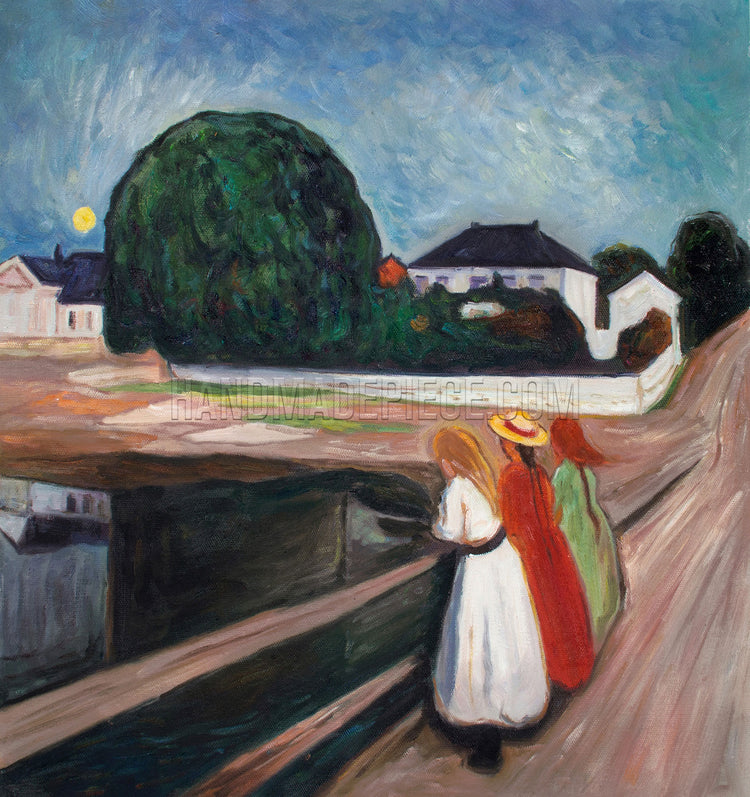
Perhaps more than any of Munch's painting, Girls on the Bridge has gained a wide measure of justly deserved popularity. The theme engaged and held Munch's interest through many versions in paint and print, from the waning years of the nineteenth century to his old age. Despite its poetic strain, Girls on the Bridge is a literal translation of a scene at Aasgaardstrand. Now, a century after its original conception, the visitor to this spot at Oslo Fjord will find essentially unchanged the elongated pier continued by an upward sloping road, the curvature of the sandy shoredline interspersed with patches of green, and the old house itself surrounded in summer by foliage and overshadowed by the often portrayed three linden trees that have grown together as if to share a common crown. Framed by a white wooden fence, all these features are literal truth, not poetic fancy. In reflecting them, Munch turned his back on a picturesque little harbor on the invisible side of the bridge, fully furnished with small craft and all the banal trappings of a motif hunter's delight. Having selected his subject with care, he adhered to it closely. Without inhibiting the transmutation from model to formal analogy, the chosen scene, on the contrary, led the artist to the perfect solution. Munch never demonstrated more convincingly his ability to achieve simultaneous separateness and wholeness. The tree forms, while singly readable, create an articulated strain of natural growth with the patches of grass that, together, stand in a contrapuntal relationship to the man-made elements - the house, the fence, and the bridge. The polyphonic opposition between these parts and its final resolution in a consonant pictorial surface is achieved with extraordinary formal command.
- Artist: Edvard Munch (Norwegian)
- Year: 1901
- Style: Symbolism
- Subject: People
- Original Location: Nasjonalmuseet for Kunst, Arkitektur og Design
- Original Size: 53.5 x 49.4 in (136 x 125.5 cm)
What you receive
A genuine hand-painted oil reproduction of your selected painting, signed by the artist on the reverse and accompanied by a certificate of authenticity.
Painting only — frame not included. The frame picker above is a visualization tool to help you choose a frame locally that fits your interior.
Depending on the size you order, your painting arrives either stretched on wooden bars (ready to hang) or rolled in a protective tube for local stretching and framing.
Shipping & Returns
Production: Each painting is hand-painted to order in our studio, typically 4–6 weeks from purchase to completion.
Delivery: Worldwide tracked shipping, typically 5–7 business days after production. Free shipping on every order.
Returns: 14-day satisfaction guarantee. If your painting arrives damaged or differs significantly from the listing, we’ll repaint it or refund in full.
Authenticity & Quality
Every reproduction is painted by skilled artists using museum-grade oil paints on cotton canvas. We do not print, transfer, or use any digital reproduction process — every brushstroke is laid down by hand.
Each canvas is signed by the artist on the back. A certificate of authenticity is included with every order.
Care Instructions
Hang in indirect light to preserve pigment vibrancy. Avoid direct sunlight, fireplaces, and humid bathrooms.
Dust gently with a dry, soft cloth (never water or cleaning solutions). The natural oil finish cures fully over 6–12 months and will deepen in tone with time.


